What if I do this all the time?

P1080199-001


In the last few hours before I officially open my shop for business, I wanted to take a deep breath and remember a moment almost a year ago in a village in India. I’ve written a bit on my personal blog about what a life-changing experience my trip was, but this sweltering afternoon in Alipura was really the moment it happened.


It was so hot outside that our group leader suggested we postpone our scheduled walk so everyone could hydrate and cool off in their air conditioned rooms until the temperature came below 100°. I couldn’t stand to be indoors, so I walked very slowly, liter of water, sketchbook, and camera in my bag, up the main road of the village, just seeing and being. I stood beside a cream-colored cow, letting my gaze wander across the alley to the two-level house in the photo above. It was painted an unusual green-tinged blue, unlike the indigo-based paints used to repel insects, and I saw Hindi writing that had faded, probably from the last wedding celebration. The slightest breeze stirred a tree branch overhead, moving its shadow away from a startling patch of emerald green that simultaneously made no sense and perfect sense, color-wise.


I took my time pondering how this building came to be colored in the way it was. Was this patch of green typically in shadow and fading unevenly from the adjacent area? Was it a newly-painted repair? Would it fade too, or would the rest of the house turn the palest cool white while this spot remained richly green?


I wanted to keep the light and colors of that green next to that blue, as it suddenly had become the most precious and important passage of color in my life. I stood with my camera ready, waiting for another gentle breeze and the few seconds I would have to make sure I’d captured the color the way I saw it.


I sighed and thought the typical office-worker’s lament to myself, “Oh, I wish I could do this all the time…”


In that instant, simultaneously the breeze nudged the tree, the sun came out brilliantly from behind a lazy cloud, the green seemed to radiate from within, I released my shutter, and something like a jolt of electricity went through my entire body, a booming voice saying, “You can. And you must.”


I’ve read about religious and spiritual callings that take a similar form, where a disembodied thought feels for all the world like the earth splitting open and reverberating with the voice of God giving explicitly clear instructions to guide one’s life. It was like the instant of falling in love or jumping off a cliff, equally terrifying and exhilarating, trembling and my whole body breaking out in chills. Everything in my mind switched instantaneously to a certainty of purpose I’ve never felt before in my life. The wind was knocked out of me, and as all the sound and colors came rushing back at once, I felt like I was going to faint, or possibly explode. I wondered for a second if I was having a heat stroke or if a bull had decided to exact revenge at precisely that moment for my history of cheeseburger-eating and had just gored my chest. But everything was coming back more clearly and vividly even than I’d known it before, including the understanding that this was something real, coming from something much bigger than myself.


A line was drawn in my life from that moment forward, where I knew, really in the depths of my heart knew, what I was put on earth to do. I am an artist, I have been all my life, and I have literally been commanded by the universe to be an artist all the time now.


As my life started completely transforming after India, a lot of things came together just so to give me the opportunity to spend the past few months rediscovering who I am as a person and an artist, and to change my days to doing that – being an artist – all the time. I am so profoundly grateful for the encouragement, problem-solving, and inspiration of the people in my life who have helped me get to what now feels like the precipice of actually doing what I’ve been meaning to do my whole life. It is no exaggeration to say I feel like there was a moment of divine intervention or personal epiphany or whatever you’d like to call it that saved my life in the instant my camera recorded this silly little multi-colored house.


I’ve faced more than a few setbacks and frustrations along the way (I’m going a little nuts about how many things I want to change already in my shop and on my site) but I want to remind myself that this isn’t something I chose. It chose me before I could speak or walk properly, when I dragged my fingers through sand at the beach and realized I could take what I experienced inside my mind and soul and share it with other people. I’ve remembered how a back-lit leaf or sunlight shimmering through new blades of grass reveal all the mysteries and wonders of the universe in an effortless instant. Art has been the greatest gift of my life, and turning back to it after neglecting it for so long feels utterly and completely like coming home.


I am incredibly excited for the challenges ahead, for giving this business my truly best effort, and for doing whatever it takes in my life to be able to keep making art and being an artist, all the time.


The green commanded me. I can, and I must.


Reflecting ethics and egalitarianism in art

.

This spring I will be relaunching my website and introducing an online shop for direct sales. Despite the enormous complexities and risks of starting a business, it’s an exciting time and a wonderful opportunity to put all my efforts into something I truly believe in and can wholeheartedly stand behind.

One of the most intriguing challenges in setting up a business is determining the way it can reflect my values and ethics. I’ve been thinking a lot about what selling art means to me, and I’ve been particularly concerned with egalitarianism, specifically can affordability and accessibility make art more egalitarian?

.

.

However necessary I believe art to be in life, it is fundamentally a luxury item. Selling art is a capitalist exchange, a trade of money for a physical commodity. To paraphrase Dave Hickey from his brilliant book Air Guitar: Essays on Art and Democracy, art and money never really touch, which is to say, the money exchanged has nothing to do with the actual value of a work of art. The price of art is usually determined by what the market will bear. Looking at the big-time Art World, buying art is often treated primarily as a financial transaction, where a painting or sculpture is purchased for its calculated return on investment and it doesn’t particularly matter what it looks like. Every friend who has worked in a blue chip gallery has stories about hedge fund guys who buy art sight unseen based on an artist’s brand value and have it delivered directly to climate-controlled storage vaults. I would rather never sell another painting again than have something I produced with my heart and soul be part of such a cold, emotionally sterile transaction.

Last spring I attended the VIP preview of a fine art fair in the city. Many of the guests in attendance had limitless money to spend on art, but seemed dismayed by a lack of new or interesting things to buy. Gallerists and dealers were working their hardest to sell them on the work they were presenting, but all the conversations I heard seemed to center around the artist’s rising prominence, recent critical acclaim, and resale value. I was stricken by a complete lack of discussion of aesthetics, beauty, or why someone would want to own and live with a piece – it was more like acquiring a designer handbag that could be hung on the wall to broadcast how much disposable income a person had and, presumably, how sophisticated a purchase could be made with it, based on what the best consultants advised. I walked around the fair feeling like what I was seeing had nothing to do with art and everything to do with money. I enjoyed seeing a few nice Chagalls and some decorative pieces I hadn’t seen in person before, but the vast majority of this fair (and most of the others I’ve attended) was a hollow, artless experience, showcasing expensive pieces with little to no emotion. I wanted nothing to do with that elitist iteration of “art,” but I was also never more certain that I needed to be working as an artist myself.

.

.

I decided I would like to make my art accessible and affordable for normal people, not just upper-1%ers. I want my art to be purchased by people who actually like it and want to live with it in their homes, not turn around and resell it at auction in a few years for a profit. I plan to make a range of products available including prints and decorative items at various price points so that someone like me or my family could own my work. I want to make pieces where a portion of the proceeds is donated to support environmental conservation efforts and charities I believe in. The financial pressure will switch to needing to sell several more pieces in a month, but I’m okay taking that on if it means that my art is affordable to more people that way.

As for accessibility, I have never believed in the esoteric coding and gimmicky obscurity that seems to predominate contemporary art. That’s not to say that art shouldn’t be challenging, but it feels deeply cynical to create pieces that can’t be understood without a pretentious manifesto, or where the ignorance of the viewer is thrown back in his face as part of the “concept” of the piece. My experience in grad school revealed a lot of dilettante philosophy wrapped up in artist’s statements, where the physical creation was secondary or tertiary to the text, always making me wonder why the art was made at all instead of writing a more intellectually rigorous text. I don’t believe art has to be “dumbed down” to make it more generally accessible either, as there are centuries of extraordinary art that can be loved and appreciated by the general public. I know it is fashionable to sneer at anything popular or mainstream, but the average viewer is actually quite sophisticated in the capacity to make and communicate observations and express emotions evoked by art. And sometimes great art is popular for a reason – everyone can see why it’s good.

Nature is a central tenant of my art, in large part because it is universally and primally understood. I think the more my art reflects the shapes, rhythms, patterns, and proportions of nature through the lens of imagination, the more accessible it becomes. When people describe visceral reactions they have to my paintings, I know I’ve done something right, and that’s what I want to keep doing.

The core values of my personal and business ethics are quality (using archival materials and techniques), environmentalism (by running a paperless office or using recycled / eco-friendly materials as much as possible), ecology (promoting awareness and connection to nature), honesty, integrity, kindness, civic-mindedness, spiritual mindfulness, and egalitarianism through accessibility and affordability. I am so excited to put these values into practice in my art and the way I run my business, and I hope to show that this system of ethics is sustainable and brings people pure, extraordinary joy.

.


Studio improvements

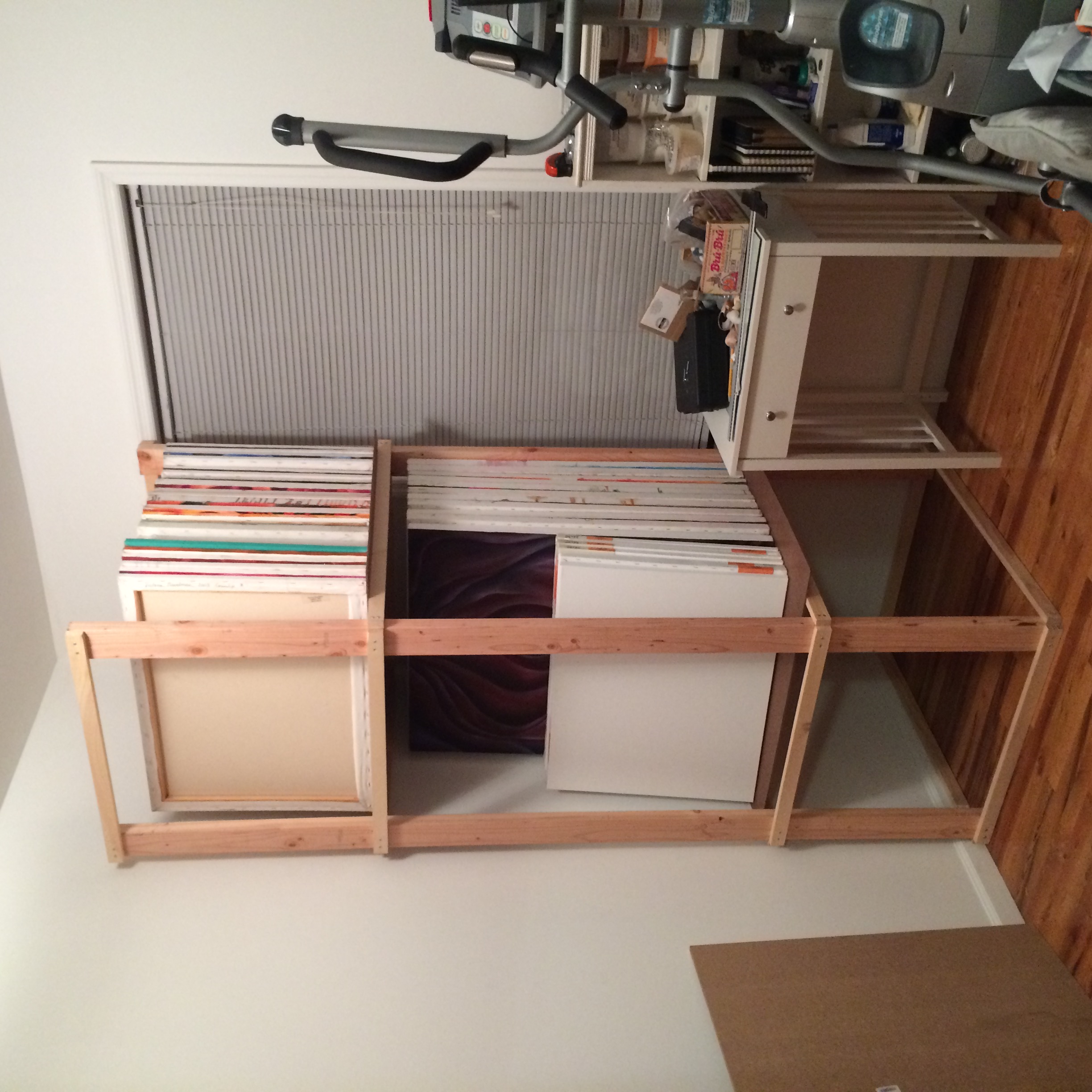
When I moved to the Bronx a year ago, I was excited to find a 2-bedroom apartment in my budget so that I could use the second bedroom as a studio space. It also functions as an exercise studio, housing my elliptical machine, yoga mats, free weights, and hula hoop. This is how it looked when it was first set up, on the day the movers brought everything:


(Obviously I didn’t need two fans.)

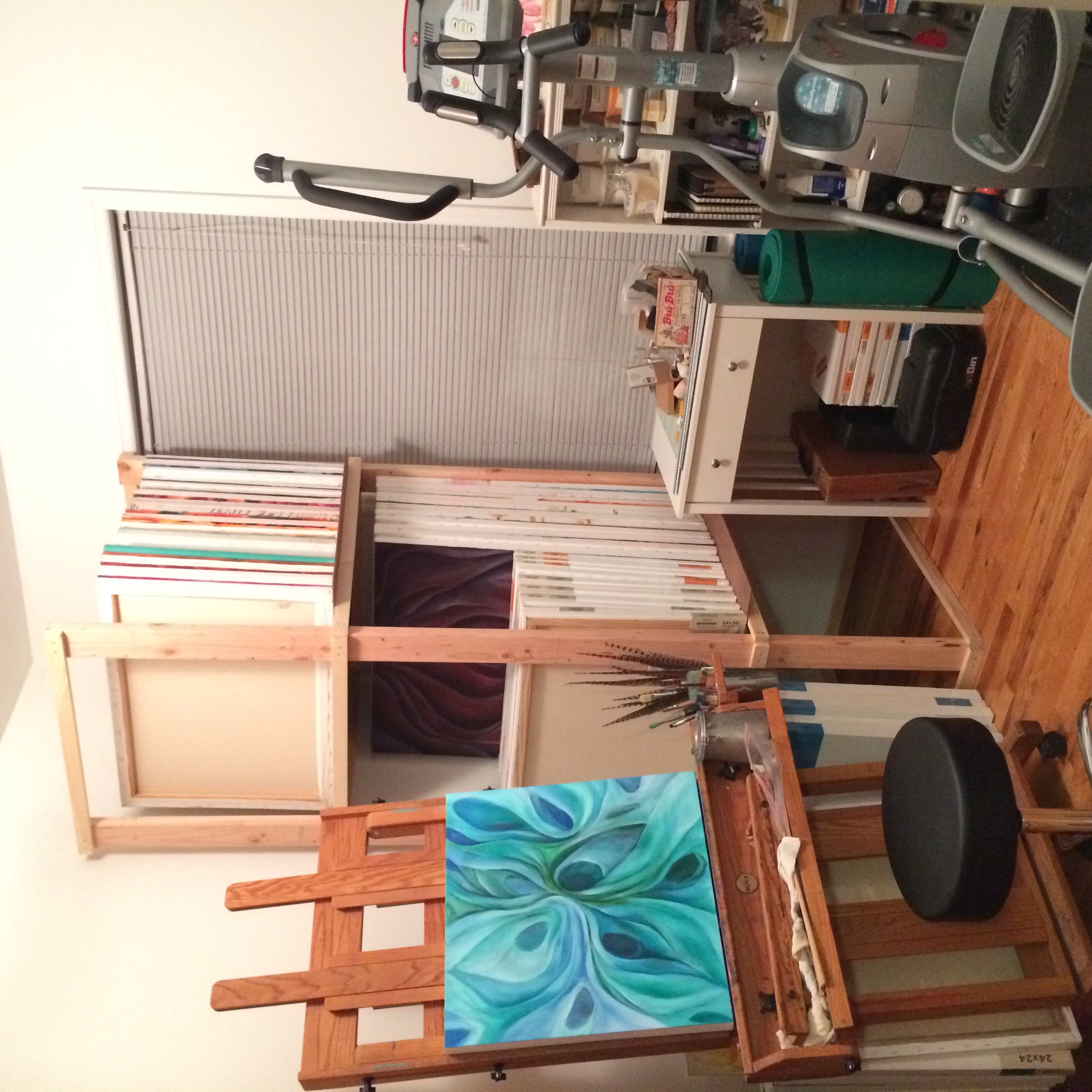
I replaced the stacked end tables with a proper taboret table (visible in the photos below) but the space was still functioning more like an overflow closet than a really workable art studio. As it became increasingly crowded and I had paintings leaning on every wall of my apartment (yes, even the bathroom), I realized it was time to reorganize things.

I worked out a fairly simple design for a storage rack that would hold two sizes of paintings and my massive photo printer. I bought about $70 of lumber and borrowed my father’s truck and tools. My mother generously spent her day off with me schlepping paintings from their attic into the truck, then everything up into my apartment, and she endured my stream of expletives when I realized I’d calculated half the measurements wrong and needed to adjust the design on the fly.


The rack stands 8 feet high, and its footprint is 30″x36″. The two most common sizes of canvas I work on are 24″x30″ and 30″x40″, so this is a perfect and efficient accommodation for both. I am planning to reinforce the top portion with another set of horizontals (not sure what I was thinking there), but it’s quite sturdy as it is.

Because I goofed the measurements, the shelves I had pre-cut didn’t fit the way I’d anticipated, but they function well enough with some overlap. After breaking two bits trying to drill the masonite shelves, I left them unattached, but that is another modification I have planned, along with painting the whole thing with a “vintage aqua” wood stain.


I was delighted to fit 52 paintings on the rack, which is most of my current inventory plus some blank canvas to move forward. I squeezed an additional 12 canvases in the base of the easel and beside it, to bring the total to 64, not counting the stack of 12″x12″ panels under my taboret.

To make room for the rack, I moved the bookcase that holds most of my paint-making and drawing supplies to the wall that the elliptical machine faces. Frankly I’m stunned it took me a year to think of this solution, but it works so much better for mixing paint on the taboret. Moving the easel out of the corner and angled against the wall opens a lot of space side to side, so that I no longer feel claustrophobic or crowded when I’m working.

I’m really delighted with the studio reorganization and feel endlessly thankful to have had so much help and support in building the rack and working out a better use of the space. I have a few further improvements planned, including setting up lighting and a space on the wall opposite the easel for photographing finished pieces, but I’m incredibly happy with the way things are progressing.


Palettes

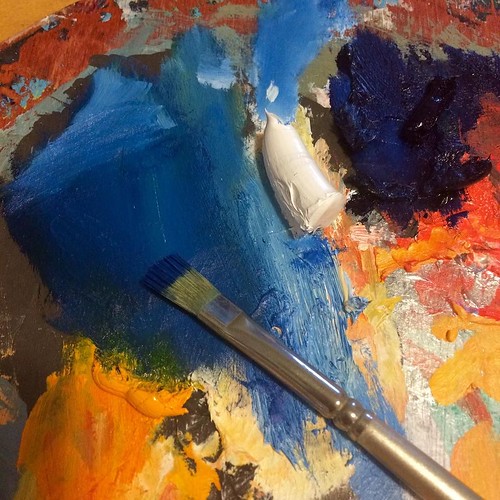
I’m currently working on a painting that’s mostly blue with traces of green and white. When I set my palette down to get a drink yesterday, I fancied the way it looked, snapped the photo below, and posted it to Instagram without much thought.


As the afternoon went by, my phone occasionally blinked with notifications for favorites or new followers, and later I realized that #palette is a pretty delightful rabbit hole on Instagram, mostly to do with cosmetics. I browsed through other artists’ palettes, reflecting on process and studio habits with a nearly voyeuristic curiosity.

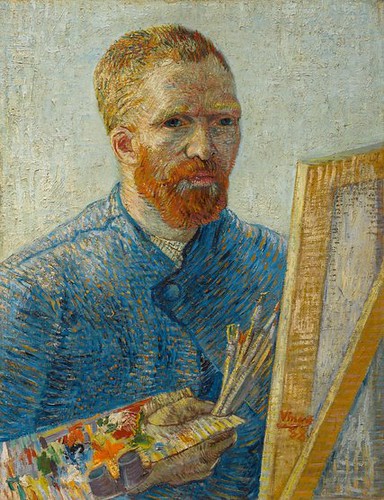
I think palettes are a bit like handwriting. Everyone learns similar ways to organize and handle their paints in art classes, but over time we develop idiosyncrasies and preferences that are deeply personal and, I think, reflect the way the hand works. Art historical publications and exhibitions are starting to include palettes like van Gogh’s, which gives tremendous insight and sometimes revelations into materials and techniques. Recognizing artists’ preferred pigments is invaluable in art conservation research, but palettes also give hints about the way artists regarded paint and their craft.


Vincent van Gogh, Self Portrait c. 1887-8
As I scrolled through Instagram, I found myself repulsed by some sloppy, muddy palettes (are they just trying to get rid of all their paint quickly??) and charmed by almost fetishistically beautiful palettes (no comment on how that may or may not relate to the actual finished artwork produced). As you can learn a lot from someone’s handwriting, I found I was often able to predict what style of paintings would be produced from various palettes.

So I looked back at mine and thought about my way of working. I tend to use only a few colors at a time, and I work almost exclusively wet-on-wet on the canvas. I go for pure pigments and am fascinated by their individual properties, so this current painting is being made primarily with a red-toned blue, cadmium yellow, and titanium white. If I were going to add another color (which I thought of doing with a phthalo turquoise and reconsidered), I’d have to consciously open it and add it to my palette, rather than dip into something that was already available.

I’m not sure if it is a reflection of my deliberate nature, or if I’m so used to being economical that I loathe the idea of wasting paint, even leaving very little on my palette by the time I finish a painting. One of my professors in undergrad suggested that if a painting starts to feel static, you can try working an unexpected color around a few places to see what happens, dab some spots of bright orange or pink on a blue-gray composition and see how you respond. I liked the idea, and for a while I would throw every color on my palette at paintings until they became big colorful messes with muddy colors. I was frustrated that forms were flattened into bodies of color and the attempts I made at drawing within the painting were reduced to color relationships instead of modeling. When I learned more about the different transparencies and opacities of various pigments, I started to simplify and more tightly control my palette, but my tendency to make basically monochromatic paintings lately suggests I may have overcorrected in my attempts at clarifying.

I have a few canvases in progress that have more complex color relationships going, and I think I’d like to challenge myself with a more robust palette when I get back to those. I don’t imagine I’m ever going to be inclined to squeeze thirty tubes of paint out to make a painting of a rose, but I do love color, so I’m curious to see how it goes.


It Felt Like Home

.


It Felt Like Home, 24″x30″, oil on canvas

.

This painting is part of my You and Me series, and I’ve been working on it for a while. I’ve been revisiting a lot of older work lately, reconnecting with the original concept, and bringing it forward to who I am as a person now.

The underpainting is incredibly dark and dreary, as it started from a broken-hearted, desolate place. I’m too embarrassed to show the whole thing, but I hope this glimpse will suffice to communicate the difference.


After traveling this summer, I didn’t want to make unhappy art anymore, so I went back to this canvas with the new sense of light and warmth I found in India, and it finally felt like what I was trying to say.

.